
How the Pharmaceutical Industry Uses "Clinical Trial" Requirements to Kill the Competition
Why "Best Available Evidence" Must Replace the RCT Monopoly in the Era of Pharmaceutical Fraud and Legitimate Off-Patent Cures

BS”D
This article, published on fenbendazole.substack.com, is a huge eye opener for anyone wondering why cheap and effective cures aren’t widely recognized, or prescribed by doctors. It’s a must-read for all, so I’m copying it here with deep gratitude to the author. Please subscribe on his site. Link to original is below.
By Ben Fen, June 7
How the Pharmaceutical Industry Uses “Clinical Trial” Requirements to Kill the Competition
Imagine you want to open a restaurant. The health department requires you to pass an inspection before you can serve customers. Fair enough. But then you find out the inspection costs $200 million — a fee only your richest competitor can afford. And the inspector works for your competitor. And the inspection checklist was written by your competitor. And if your restaurant somehow scrapes together the money and passes anyway, your competitor gets to decide whether the results are published enabling you to open.
That is not a health inspection. That is a protection racket.
That is also, with almost perfect structural fidelity, how the pharmaceutical industry uses the randomized controlled trial (RCT) — the supposed gold standard of medical evidence — to keep cheap, effective, off-patent drugs away from cancer patients who desperately need them.
This is the story of how that racket works, why fenbendazole is an important current example of it, and why the silence of the entire pharmaceutical establishment in the face of documented, industrial-scale fraud is not a mystery. It is a confession.
— — —
First: What Is an RCT, and Why Does It Matter?
A randomized controlled trial is a medical study in which patients are randomly assigned to either receive a treatment or a placebo (or a comparison treatment), and the results are tracked over time. The randomization is supposed to remove bias — if you divide patients randomly, neither group should be systematically healthier or sicker than the other at the start, so any difference in outcomes can more reliably be attributed to the treatment.
In theory, it’s a good idea. In practice, it has become the most expensive marketing credential in human history.
Here’s the problem: running an RCT costs, on average, between $19 million and $225 million (Moore et al., 2018; Coulter, 2024). For a cancer drug trial, the per-patient cost alone averages nearly $60,000. You only get that money back if the drug you’re testing can be sold at a patent-protected premium for years after approval.
Fenbendazole cannot. It’s a veterinary dewormer that has been off-patent for decades. It costs pennies per dose. Any company could make it. No company can own it. No company will spend $200 million to prove it works against cancer, because there is no way to recoup that investment.
So no trial gets funded. And because no trial gets funded, oncologists are told there is “no evidence” that fenbendazole works. And because there is “no evidence,” cancer patients are denied access to a drug that costs less than a cup of coffee per day and has documented remissions in peer-reviewed case reports.
This is not a gap in the science. It is a structural guarantee built into a system designed by people who profit from status quo expensive cancer drugs.
The Good Housekeeping Seal That Money Can Buy
You’ve seen the Good Housekeeping Seal of Approval on products in the grocery store. You might think that the seal implies that an independent organization tested the product and confirmed it meets a quality standard. What most people don’t know is that manufacturers pay (in the form of expensive advertising commitments) to receive the seal. It is, in practice, a marketing label dressed up as independent verification. Essentially, the manufacturer bribes the publisher to label its products as superior in return for advertising in those publications.
Fortunately, no one’s life is going to be adversely affected if they bought Brand A toilet paper, and not Brand B, because Brand A had the seal of approval. However, because the RCT designation carries the same perceptual weight on a drug as the Seal of Approval does on toilet paper — only now that seal can have life-or-death consequences.
The “randomized controlled trial” label does not mean a drug was tested fairly. It means someone spent between $19 million and $225 million on a process that the pharmaceutical industry has spent decades learning to manipulate toward whatever result they want.
How thoroughly manipulated? Researchers at Stanford and elsewhere have documented the full playbook. A Midwestern Doctor, writing in a comprehensive analysis of pharmaceutical research tactics, lays out the complete toolkit (A. Midwestern Doctor, 2024):
Enroll only the patients most likely to respond to your drug — and exclude up to 90% of potential participants who might show side effects. Use a “placebo” that itself causes side effects, so that your drug’s harms get lost in the noise. End the trial early if the data briefly looks good — before the real picture emerges. Switch the outcome you’re measuring after you see the data — which was done in 63% of published trials. Present a 1% benefit as “50% more effective” by using relative rather than absolute percentages. Bury the trials that showed your drug didn’t work. Publish the ones that did — sometimes the same positive trial more than a hundred times under different author names.
One olanzapine study was published 143 separate times. An FDA analysis of antidepressant trials found that the published literature made the drugs look 32% more effective than all submitted trials — including the unpublished negative ones — actually showed (A Midwestern Doctor, 2024).
“It is simply no longer possible to believe much of the clinical research that is published, or to rely on the judgment of trusted physicians or authoritative medical guidelines.” — Dr. Marcia Angell, former Editor-in-Chief, New England Journal of Medicine
That quote is not from a fringe critic. Marcia Angell ran the most prestigious medical journal in the world for two decades. She said this in 2009, after watching the process from the inside (Angell, 2009). The situation has gotten worse since then.
And here is the most damning part: not one pharmaceutical company has publicly called out another for this manipulation. Not one journal editor has resigned in protest of competitor journals’ fraud. Not one academic medical center has broken ranks to say that the trial literature is corrupted and their competitors’ products’ approvals were bought rather than earned.
If bad actors were the exception in an otherwise honest industry, good actors would have every reason to expose them — to protect their own reputation, to gain competitive advantage, to serve the science they claim to revere. The silence is total. That silence tells you that the fraud is not the exception. It is the system. Everyone who benefits from the system has agreed, implicitly, not to expose it. The good actors, if they exist in any meaningful number, are complicit by silence.
This situation just happened to the Makis et al (2025) Case Reports in Oncology journal article describing three of our case reports that demonstrated fenbendazole can cure cancer. The paper was just retracted in Jan 2026, not due to a scientific error, but due to a fabricated undeclared conflict of interest charge. Relevant to this conversation, not a single Editor from any other journal, not a one, has offered to publish the paper with the declared conflict of interest statement. They all appear to stick together.
The Cartel’s Toolkit: Same Tactics, Different Name
What the pharmaceutical industry has done with the RCT evidence requirement is, in structural terms, identical to tactics that federal antitrust law has already recognized as illegal.
Pay-for-Delay: In 2008, the FTC sued Cephalon for paying four generic drug manufacturers $200 million to stay off the market and keep the generic version of its sleep drug Provigil unavailable. Patients paid billions in unnecessary overcharges. The case settled in 2015 for $1.2 billion — the largest antitrust settlement in FTC history at the time (FTC, 2015). The Supreme Court confirmed that paying competitors to delay entry into the market violates antitrust law.
Patent Thickets: AbbVie’s arthritis drug Humira had its core patent expire in 2016. Rather than allow competitors to enter the market, AbbVie filed 132 additional patents — more than 90% of them in the two years before the core patent expired — covering trivial variations of the drug: different formulations, different dosing schedules, different manufacturing processes. None of these changes made Humira more effective. All of them extended AbbVie’s monopoly. Biosimilar competitors were kept out of the U.S. market until 2023 — seven years after the core patent expired. AbbVie earned more than $200 billion on Humira during this period (Commonwealth Fund, 2025).
Product Hopping: When Actavis’s Alzheimer’s drug Namenda was about to face generic competition, the company tried to pull the original version off the market and push patients onto a new version covered by patents extending a decade further. The New York State Attorney General sued, and a federal appeals court ruled that this “hard switch” was an illegal extension of monopoly power.
The antitrust laws — the Sherman Act, the Clayton Act, the FTC Act — exist precisely to prevent this kind of conduct. They prohibit maintaining a monopoly through exclusionary means. They have been successfully applied to pay-for-delay schemes and patent thickets.
They have not been applied to the pharmaceutical industry’s use of the RCT evidence requirement as an exclusionary mechanism against off-patent drugs. The structure is identical. A terminal cancer patient denied access to fenbendazole because it lacks an RCT — when no RCT will ever be funded because fenbendazole can’t be patented — has been harmed by the same exclusionary logic as a patient paying $80,000 a year for Humira seven years after its patent expired. The law that could address this exists. The political will to apply it does not.
— — —
So What Evidence Does Actually Exist for Fenbendazole as a Cancer Treatment?
Here is what the “no evidence” claim actually means in practice: no one has funded a large, multi-center, double-blind RCT for fenbendazole as a cancer treatment, because no patent holder would profit from the results.
Here is what actually exists:
The Biology. Fenbendazole has documented anticancer activity through at least twelve separate mechanisms — disrupting cancer cell division, cutting off cancer cells’ glucose supply, reactivating the p53 “kill switch” that cancer cells suppress, blocking the formation of new blood vessels that feed tumors, and multiple others. These are not speculative pathways. They are the same mechanisms that expensive patent-protected cancer drugs target — and in many cases, fenbendazole hits them simultaneously.
The Case Reports. More than 400 documented case reports of cancer patients self-administering fenbendazole, many showing tumor regression, remission, or stabilization, have been compiled and categorized by cancer type (this Substack; OneDayMD, 2025). In May 2025, three of the cases initially reported in this Substack were formally published in Case Reports in Oncology, a peer-reviewed journal, by Dr. William Makis and colleagues — documenting complete remission in metastatic breast cancer, near-complete remission in metastatic prostate cancer, and remission in advanced melanoma, with follow-up periods of up to nearly four years and no serious side effects (Makis et al., 2025). That paper was subsequently retracted, not for any scientific flaw, but because the editor — who has disclosed financial relationships with GlaxoSmithKline and AstraZeneca and works for an institution dependent on expensive cancer treatment revenues — decided that Dr. Makis had a “conflict of interest” (Supple, 2026). His conflict: he treats cancer patients with fenbendazole. The editor’s conflicts: he takes money from drug companies that compete with inexpensive, off-patent, safe drugs like fenbendazole.
The Prospective Study. In June 2026, a team including researchers from Yale School of Public Health published a prospective study of 197 cancer patients prescribed ivermectin and mebendazole — antiparasitic drugs closely related to fenbendazole — through a U.S. telemedicine platform. At six months, 84.4% reported clinical benefit: no evidence of disease, tumor shrinkage, or stable disease. This is the largest real-world human study of antiparasitic cancer treatment ever published (Hulscher et al., 2026).
That is not “no evidence.” That is extensive, consistent, mechanistically grounded, and growing evidence from multiple independent sources across multiple cancer types. The claim that fenbendazole “lacks evidence” means only that it lacks a $200 million industry-sponsored trial. It does not mean — and has never meant — that the evidence doesn’t exist.
At present, the Best Available Evidence indicates that some anti-parasitic drugs, including fenbendazole, are capable of eradicating or curing many types of cancers. That’s what the case reports show and the science compellingly supports. If this discovery was a monetizable Big Pharma discovery, you would hear about it night and day on all the mockingbird, Pharma-funded media.
— — —
If the Trial Were Funded, It Would Be Rigged
Here is the uncomfortable next question: even if, hypothetically, someone funded an RCT of fenbendazole — what would stop the same industry that has documented means of manipulation from engineering a negative result?
Nothing. The playbook is available. Enroll only the patients least likely to benefit. Compare fenbendazole at a low dose against an optimally dosed chemotherapy. Measure a surrogate endpoint that favors the comparison drug. Add rescue medications to the placebo arm. Stop the trial at the moment the data looks worst for fenbendazole. Switch the primary outcome after seeing the results. Publish the negative finding in every journal simultaneously while burying any positive signal in the subgroup data that was conveniently left out.
A Midwestern Doctor has documented every one of these techniques as standard practice in industry-sponsored trials (A Midwestern Doctor, 2024). The RCT label would guarantee nothing about the fairness of a fenbendazole trial conducted under industry-influenced conditions. It would guarantee only that the process was expensive, complex, and opaque enough that most people would trust the result without questioning how it was obtained.
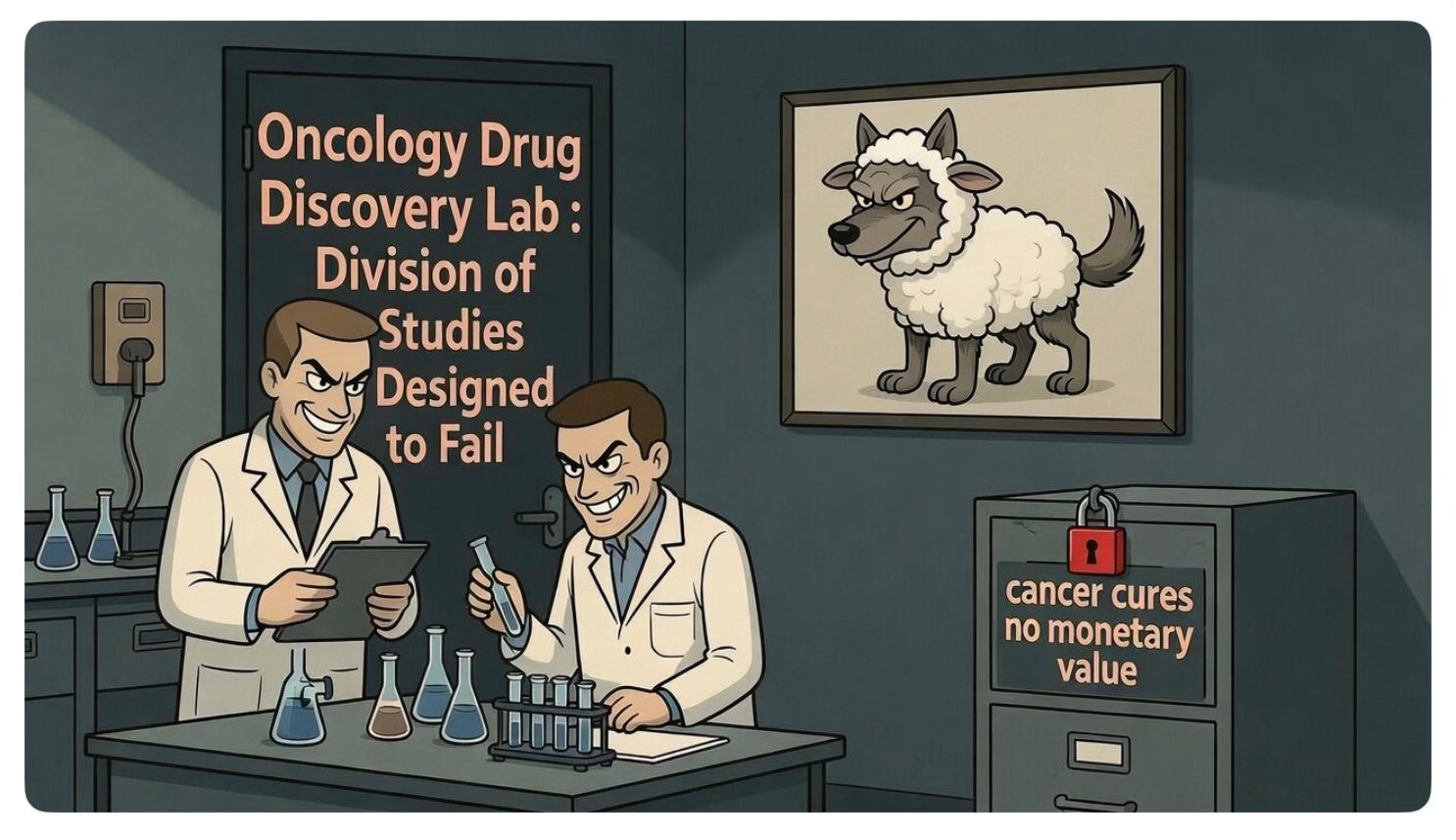
Think it’s a far-fetched conspiracy theory that pharma would ever suppress a legitimate cancer cure? In my book, Cancer is a Parasite, I prove that pharma did discover that an antiparasitic like fenbendazole cured cancer in 1976. Those involved were so giddy they actually renamed it oncodazole. Shortly thereafter oncodazole was effectively erased from the scientific literature and awareness. I provethis using the published scientific record.
— — —
The Real Precautionary Principle
You’ve probably heard arguments that fenbendazole shouldn’t be used “until we have more evidence” because of the precautionary principle — the idea that we shouldn’t expose patients to unproven treatments.
The precautionary principle is supposed to protect patients from harm. Applied honestly, it has to weigh the risk of the treatment against the risk of not using it.
Fenbendazole has been used in veterinary medicine for decades. It has been self-administered by tens of thousands of human cancer patients. There is no conclusively documented serious toxicity profile. It costs almost nothing. The risk of taking fenbendazole is, based on everything we currently know, very low.
The risk of not taking fenbendazole, for a patient with metastatic cancer who has exhausted standard options, is death.
In this context, the precautionary principle does not argue against fenbendazole. It argues for it. A precautionary principle that demands a $200 million industry trial before a safe, cheap drug can be considered, while simultaneously allowing manipulated trials of expensive drugs to sail through approval, is not protecting patients. It is protecting revenue.
— — —
What Honest Science Actually Looks Like
To be clear: the argument here is not that trials are worthless or that evidence doesn’t matter. The argument is that the evidence hierarchy should be applied honestly — which it currently is not.
“Best available evidence” means exactly what it says: the best evidence that actually exists. Not the best evidence that could theoretically exist if someone spent $200 million. For fenbendazole, the best available evidence is: mechanistically documented anticancer activity, a 400+ case report database, peer-reviewed published case series, and a prospective observational cohort in a major oncology journal showing 84.4% clinical benefit. By the standards applied to observational evidence in cardiology, infectious disease, and every other field where $200 million trials are unavailable or impractical, that evidence base justifies serious clinical consideration.
The most credible published medical researchers of the last generation — John Ioannidis at Stanford, Marcia Angell at the NEJM, Peter Gøtzsche at the Nordic Cochrane Centre — have all said, in different ways, that the RCT literature as currently published cannot be trusted at face value (Ioannidis, 2005; Angell, 2009; Gøtzsche, 2013). Ioannidis showed mathematically that the majority of published research findings are likely false. Angell said she could no longer believe much of what was published after two decades of watching it from the inside. Gøtzsche compared the pharmaceutical industry to organized crime in its systematic manipulation of the evidence base.
These are not outsiders. These are people who built their careers inside the system and eventually could no longer stay silent about what they saw.
Ioannidis showed mathematically that the majority of published research findings are likely false. Angell said she could no longer believe much of what was published after two decades of watching it from the inside. Gøtzsche compared the pharmaceutical industry to organized crime in its systematic manipulation of the evidence base.
— — —
The Bottom Line
You are being told, every time you ask a medical professional about fenbendazole, that there is “no evidence” it works against cancer.
What you are not being told is that the people saying this are told to say this by the same people who designed the evidence standard, fund the trials, publish the results, retract the inconvenient ones, pay each other consulting fees, and rotate through the regulatory agencies that enforce the standard. And that the evidence standard they designed happens to require spending $200 million — money only they can recoup through patent-protected drug prices — before a treatment is considered real.
You are not being told that the largest antitrust settlement in FTC history involved a pharmaceutical company paying $200 million in bribes to keep a generic drug off the market. Or that AbbVie spent $200 billion in revenue that patients and insurers paid because a patent-expired drug was kept under monopoly control through 132 trivial secondary patents. Or that the courts have found these behaviors to be illegal — and yet the identical behavior, executed through evidence requirements rather than patent filings, continues without challenge.
You are not being told that in June 2026, 197 cancer patients treated with related antiparasitic drugs showed 84.4% clinical benefit. Or that this result was published in a peer-reviewed oncology journal. Or that the doctors who published it are not fringe actors — they include epidemiologists from Yale.
You are not being told any of this because the people whose job it is to tell you — the journals, the academic medical centers, the regulatory agencies, the cancer treatment guidelines committees — are financially embedded in the system that benefits from you not knowing.
I heard a wise man say, “More people live off of cancer than die from it!”
The question is not whether fenbendazole has evidence. The question is whether you trust the people who decide what counts as evidence.
Given everything documented here, you should not.
Original article link:

References
A Midwestern Doctor. (2024). How to rig a trial: A comprehensive taxonomy of pharmaceutical research manipulation[Substack]. The Forgotten Side of Medicine. https://www.midwesterndoctor.com/p/how-pharmaceutical-companies-manipulate
Angell, M. (2000). Is academic medicine for sale? New England Journal of Medicine, 342(20), 1516–1518. https://doi.org/10.1056/NEJM200005183422009
Angell, M. (2004). The truth about the drug companies: How they deceive us and what to do about it. Random House.
Angell, M. (2009, January 15). Drug companies & doctors: A story of corruption. New York Review of Books. https://www.nybooks.com/articles/2009/01/15/drug-companies-doctorsa-story-of-corruption/
Case Reports in Oncology. (2026). Retraction: Fenbendazole as an anticancer agent? Case Reports in Oncology, 19(1), 169. https://doi.org/10.1159/000549387
Commonwealth Fund. (2025, November 13). How drugmakers use the patent process to keep prices high. https://www.commonwealthfund.org/publications/explainer/2025/nov/how-drugmakers-use-patent-process-keep-prices-high
Coulter, B. (2024, March 5). Controlling clinical trial costs. Anju Software. https://www.anjusoftware.com/insights/eclinical/clinical-trial-costs/
Federal Trade Commission. (2015, May 28). FTC settlement in Cephalon pay-for-delay case. https://www.ftc.gov/news-events/news/press-releases/2015/05/ftc-settlement-cephalon-pay-delay-case-ensures-12-billion-ill-gotten-gains-relinquished-refunds-will
Goldacre, B. (2012). Bad pharma: How drug companies mislead doctors and harm patients. Fourth Estate.
Gøtzsche, P. C. (2013). Deadly medicines and organised crime: How big pharma has corrupted healthcare. Radcliffe Publishing.
Health Affairs. (2018, May 22). A preferable path for thwarting pharmaceutical product hopping. https://www.healthaffairs.org/content/forefront/preferable-path-thwarting-pharmaceutical-product-hopping
Hulscher, N., Victory, K., Thorp, J. A., Pinsky, D., Diaz-Villalobos, A., Gillooly, P., Coulson, F., Annazone, M., Radesi, C., Brooks, J., McCullough, P. A., & Risch, H. (2026). Real-world clinical outcomes of ivermectin and mebendazole in cancer patients: Results from a prospective observational cohort. Anticancer Research, 46(6), 3243–3255. https://doi.org/10.21873/anticanres.18194
Ioannidis, J. P. A. (2005). Why most published research findings are false. PLOS Medicine, 2(8), e124. https://doi.org/10.1371/journal.pmed.0020124
Makis, W., Baghli, I., & Martinez, P. (2025). Fenbendazole as an anticancer agent? A case series of self-administration in three patients [Retracted]. Case Reports in Oncology, 18(1), 856–863. https://doi.org/10.1159/000546362 Case Reports in Oncology. (2026). Retraction statement: Makis et al., “Fenbendazole as an Anticancer Agent? A Case Series of Self-Administration in Three Patients.” Case Reports in Oncology, 19(1), 169. https://doi.org/10.1159/000549387
Moore, T. J., Zhang, H., Anderson, G., & Alexander, G. C. (2018). Estimated costs of pivotal trials for novel therapeutic agents approved by the US Food and Drug Administration, 2015–2016. JAMA Internal Medicine, 178(11), 1451–1457. https://doi.org/10.1001/jamainternmed.2018.3931
Nguyen, J., et al. (2024). Oral fenbendazole for cancer therapy in humans and animals. Anticancer Research, 44(9), 3725–3735. https://doi.org/10.21873/anticanres.17197
OneDayMD. (2025). Exploring the anticancer potential of fenbendazole: A review of 170 anecdotal case reports. https://www.onedaymd.com/
Richardson, R. A. K., Hong, S. S., Byrne, J. A., Stoeger, T., & Amaral, L. A. N. (2025). The entities enabling scientific fraud at scale are large, resilient, and growing rapidly. Proceedings of the National Academy of Sciences, 122(32), e2420092122. https://doi.org/10.1073/pnas.2420092122
Supple, W. F., Jr. (2026, March 20). They retracted the 2025 paper that proved fenbendazole cures cancer. Fenbendazole: The Science of Antiparasitic Cancer Treatment [Substack]. https://fenbendazole.substack.com/p/they-retracted-the-2025-paper-that
Supple, W. F., Jr. (2026). Cancer is a Parasite: Kill it with the Safe, Over-the-Counter Antiparasitic Fenbendazole. Skyhorse/MAHA Books.
Here's something else the RCT's are used for: the FDA recently impounded a purchase I made of meds from India. The notice told me that I couldn't count on overseas manufacturing to be "safe and effective." WHen I argued that the FDA inspects plants in India and that half our over the counter meds are manufactured there, the "Compliance Officer" (you can;t make this stuff up!) said that inspected is different than approved, which requires an RCT.....Happy to share with any responsible party who wants to further investigate how our freedoms as citizens are being curtailed.
Excellent article. Well written used to understand and make sense of something otherwise complicated.